
Chocked, strapped and staggered
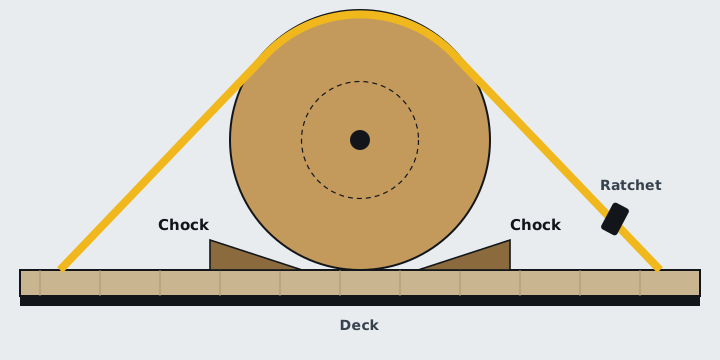
Large reels stand on edge in two staggered rows, each wedged with a chock under the flange on both sides so it cannot roll, then strapped across the deck. Small reels are stacked flat and strapped as blocks. The driver brings the chocks and straps; a dock only needs the reels standing clear and a forklift or room to roll them.
Step by step
Stand the first reel at the headboard
Set the first large reel on edge against the front of the deck, its flanges running along the trailer, and chock it under the flange front and back.
Stagger the second row
Set the next reel in the second row so its flange sits beside the gap in the first row, then chock it the same way.
Work back down the deck
Keep alternating rows to the back of the deck, chocking every reel before the next one goes on.
Strap across the deck
Run straps over each pair of reels and ratchet them down to the deck rails, then check every strap and chock before the truck moves.
Why reels are loaded this way
A reel is a wheel. Stood on edge, it wants to roll forward under braking and sideways in a turn. Chocks under the flange stop the roll, and straps over the top hold it down against bumps. Dura-Line's loading chart, written so its customers return reels safely, shows empties on edge in two rows on a 102 inch wide truck with the flanges staggered, and that is the pattern we follow for every reel from 48 inches up.
Staggering does two jobs. It fits more reels on the deck, and it locks the rows against each other, because each reel's flange sits beside the narrow drum of the reel next to it. A straight double row leaves gaps that let reels shift.
Small reels in blocks
Reels up to 42 inches go on flat, stacked in columns two to four high. Each stack is squared up, then the stacks are strapped together as a block so the edge reels cannot slide off. A stack of 30 inch reels three high is about 66 inches tall, low enough to strap tightly and to see over from the cab mirror.
Height on the deck
California's legal height is 14 feet. A reel on edge on a flatbed stands its flange diameter above a deck that is roughly five feet off the road. A 96 inch reel on a flatbed is about thirteen feet to the top of the flange, close enough to the limit that we plan the tallest reels on a step deck, whose lower rear section buys back about a foot and a half.
What the driver needs from your dock
- Reels standing on edge or stacked flat, not leaning into each other.
- Arbor holes clear, so a bar or fork tine can go through.
- A forklift and someone to drive it for reels over 48 inches, or room and a firm surface to roll them.
- The pickup window you gave us, with the gate open.
- Damaged reels set to one side.
The staging guide covers how to set up a stack in the days before the run, so loading takes minutes rather than an hour.
Loading order on a mixed run
A run with several stops is loaded from the front of the deck backwards, heaviest and tallest first. If the first stop of the day has big bolted reels, they go against the headboard; small flat stacks from later stops fill in behind. When the first stop is small, the driver leaves deck at the front for the larger stop down the lane, which is why we ask every stop for counts by size before the run is planned. Getting the order wrong means unloading and reloading at the side of a road.
Problems that slow a load down
- Reels laid flat in a heap, flanges interlocked, so each has to be prised out.
- Reels stood in mud or soft dirt that the forklift sinks into.
- Leftover cable tails nailed to the drum, which snag straps and gloves.
- Pallets, scrap and cable offcuts mixed into the stack.
- Gates locked or the forklift driver at lunch during the window.
None of these stops a pickup, but each one costs time on a run that has other stops waiting.
Words on this page
- Chock
- A wedge under a reel's flange that stops it rolling on the deck.
- Deck
- The flatbed or step-deck trailer floor; 102 inches wide on a California legal trailer.
- Flange
- The round end of a reel; its diameter (24 to 96 inches and up) is how reels are sized, sorted and loaded.
- Pickup window
- The span of hours a dock is open and staffed for loading.
- Step deck
- A trailer with a lower rear deck, used when tall reels would break the 14 foot height limit on a flatbed.
Read next
Securing questions
Do we need to supply chocks or straps?
No. The driver brings them. What helps is reels standing clear of each other with their arbor holes free, so forks or a bar can go through.
Why do small reels lie flat instead of standing up?
Laid flat and stacked, small reels use the deck height and form square blocks that strap down tightly. On edge they would waste space and need a chock each.
What if a reel is broken?
A split flange or a loose stave can still travel for recycling, laid flat or bound. Tell us which ones are damaged; they load last so they don't hold up the sound reels.
How long does loading take?
With a forklift and reels standing clear, a full deck of large reels loads in well under two hours. Hand loading small reels takes longer; a few dozen take minutes.
Why not just tie reels together with rope?
Rope stretches and frays on rough plywood edges. Ratchet straps rated for cargo, tensioned against the rails, keep their grip over potholes, railroad crossings and the grade up Cajon Pass.
Are tarps used?
Rarely. Empty wooden reels shrug off a dry Southern California day; in steady rain, wet wood simply gets graded when it dries out.