
How many reels make a load
A 53-foot flatbed holds about 416 empty 24-inch reels laid flat, or about 16 empty 96-inch reels stood on edge. Everything in between depends on the flange size, because the flange decides whether a reel lies flat in a stack or stands up in two rows across the 102-inch deck. These are planning estimates, not promises: the driver counts what actually goes on.
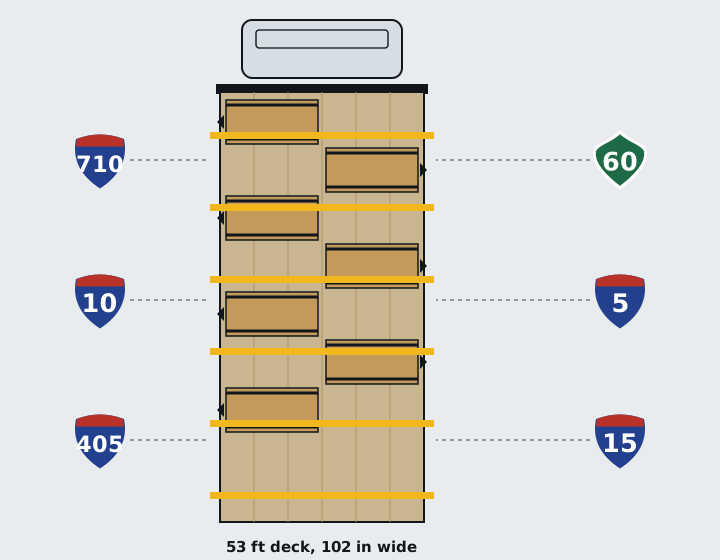
Empties per deck, by flange
This is the table every quote starts from. Small reels are laid flat on a flange and stacked inside a 72 inch planning height; large reels stand on edge in two rows with the flanges staggered. The counts for small reels are worked out from Okonite's published reel dimensions; the counts for large reels come from Dura-Line's loading chart for empty reels on a 102 inch wide truck. Where the chart gives a range, we plan on the low end.
| Flange | How it loads | Empties per deck (est.) | Empty weight, lb | Request |
|---|---|---|---|---|
| 24 in | Flat, 4 across, 4 high | 416 | 23 to 24 | Request |
| 30 in | Flat, 3 across, 3 high | 189 | 39 | Request |
| 36 in | Flat, 2 across, 3 high | 102 | 64 to 77 | Request |
| 42 in | Flat, 2 across, 2 high | 60 | 90 to 100 | Request |
| 48 in | On edge, two staggered rows | 26 to 30 | 106 to 177 | Request |
| 60 in | On edge, two staggered rows | 24 to 28 | 187 to 347 | Request |
| 72 in | On edge, two staggered rows | 20 to 24 | 204 to 592 | Request |
| 84 in | On edge, two staggered rows | 18 to 22 | 223 to 920 | Request |
| 96 in | On edge, two staggered rows | 16 to 18 | 250 to 1,199 | Request |
A mixed deck from one yard
Most stacks we see are mixed. The arithmetic is the same for every one: take each size's count, divide by the number of empties of that size a deck holds, and add the shares. Under a quarter of a deck rides along on a run that is already going your way. A quarter to most of a deck is a part load. Around a full deck, the run is yours. The load planner does this sum for you and draws the result.
The pages in this section
What limits a load: space, not weight
Empty reels are bulky and light. A deck of 416 small reels weighs about five tons; a deck of sixteen of the heaviest 96 inch builds Okonite lists weighs under ten. A flatbed carries far more than either, so an empty-reel load runs out of floor long before it runs out of weight. That is why we ask for the flange size first and the weight almost never.
Width and height are the hard limits. California's legal width is 8.5 feet, which is the 102 inch deck, and its legal height is 14 feet. Small reels stacked flat stay low. Large reels on edge are as tall as their flange plus the deck, so the tallest ones go on a step deck instead of a flat one. Length is the last limit: two staggered rows of reels need most of a 53 foot deck before the count tops out.
How the share decides the date
A ride-along waits for the next run on its lane, which on busy lanes like the ports and the San Gabriel Valley is soon. A part load sets a run of its own, often within the week, with smaller stops added around it. A full run is booked to the dock's pickup window. Recurring yards that fill a deck every few weeks get a standing slot.
Words on this page
- Deck
- The flatbed or step-deck trailer floor; 102 inches wide on a California legal trailer.
- Flange
- The round end of a reel; its diameter (24 to 96 inches and up) is how reels are sized, sorted and loaded.
- Traverse
- The inside width between the flanges; with the flange size it sets how much deck a reel takes up.
- Chock
- A wedge under a reel's flange that stops it rolling on the deck.
- Full run
- A pickup that fills a 53 foot deck on its own.
- Part load
- A stop that takes a real share of a deck, roughly a quarter to most of it, so the run is planned around it.
- Step deck
- A trailer with a lower rear deck, used when tall reels would break the 14 foot height limit on a flatbed.
Read next
Truckload questions
Why do you ask for the flange size before anything else?
Because it decides the load. Four hundred 24 inch reels and sixteen 96 inch reels both fill a deck. Without the flange size, a count of reels tells us almost nothing about the truck.
Is a full truckload cheaper per reel than a ride-along?
It is simpler to plan, because the run is built around you. Whether it changes the price depends on the reels themselves; we talk about value once we know the sizes and condition.
Do you use 48 foot trailers too?
Our planning counts assume a 53 foot deck. Dura-Line's chart covers 48 and 53 foot trucks with the same counts for large reels on edge, because two staggered rows rarely use the last few feet.
What if my reels are taller than the legal height on a flatbed?
Above about 90 inches, deck height starts to matter against California's 14 foot limit. We plan those on a step deck, which sits lower behind the gooseneck.