
Guides
Short, practical guides for anyone with reels in a yard or a reel on the way home: how to measure one, whether it will sell or needs recycling, how to stage a stack for pickup, how to move a big spool without hurting anyone, what to do with empties after a job, and why a reel does not belong in the green bin.
The guides
Reel sizes explained
Reels are named in three numbers: flange diameter, inside traverse and drum diameter, in inches. A 36 × 18 × 12 reel has a 36 inch flange, 18 inches between the flanges and a 12 inch drum. For a pickup, only the first number matters, because the flange decides whether a reel stacks flat or stands on edge and how many fit on a 102 inch deck. For reusing a reel, the other two matter: the traverse and drum set how much cable it holds, and the overall width sets how tall it stands as a table. Start with reels by size and type for the full range.
What makes a reel resellable
Four things: flat flanges, every stave in place, a round arbor hole, and dry, sound wood. A reel with all four has buyers among contractors, growers and makers. A split flange or a chewed arbor hole usually means recycling, not resale. No reel is worth much on its own; a pickup that collects many cheaply is what makes resale work.
Take-back programs and when to use them
A full truck of one maker's reels, in good condition, fits that maker's take-back program if it runs one. Service Wire's, for example, takes its own nailed reels from 30 to 72 inches in full truckloads, with sound wood and undamaged arbor and drive holes. A mixed stack, a part load or a dozen reels in four sizes does not, and that is what our runs are for. The take-back programs page sets them side by side.
Handling safely
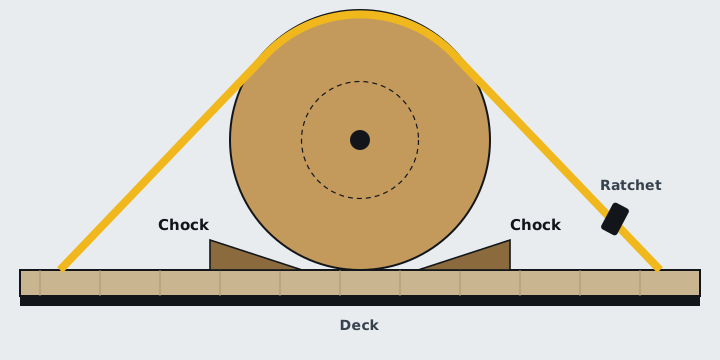
Reels are round and heavy. Never stand downhill of one, never roll one faster than walking pace, and chock any reel that stands on edge. Above 48 inches, use a forklift. The securing reels page shows how drivers chock and strap them on a flatbed, and the same chocks work in a yard.
Storing reels while they wait
Keep reels off bare soil, on their flanges or on edge with chocks, out of standing water and away from a fence line where weeds grow through them. A reel stored dry for a year still sells. A reel left in a puddle for a winter usually doesn't.
Who writes these
The guides come from the same arithmetic and handling rules our runs follow: deck counts from the loading charts cable makers publish, weights from reel tables, legal truck limits from Caltrans, and the habits of drivers who chock and strap reels every working day. Where a guide cites a figure, the source is listed at the bottom of its page.
Words on this page
- Flange
- The round end of a reel; its diameter (24 to 96 inches and up) is how reels are sized, sorted and loaded.
- Traverse
- The inside width between the flanges; with the flange size it sets how much deck a reel takes up.
- Drum
- The barrel between the flanges that the cable winds on; its diameter sets how much cable a reel holds.
- Arbor hole
- The centre hole a reel stand's spindle goes through; a torn or oval arbor hole takes a reel out of service.
- Stave
- One of the boards fixed around the drum between the flanges; loose or missing staves weaken a reel.
- Chock
- A wedge under a reel's flange that stops it rolling on the deck.
Read next
Before you read
Which guide should I read first?
If you have reels to get rid of, after the job. If you are buying one, moving large spools. If you are booking a pickup, measuring a reel and then staging.
Are these guides specific to Southern California?
The handling advice works anywhere. The disposal and recycling advice reflects how wood is collected in Los Angeles, Orange, Riverside and San Bernardino counties.