
Measuring a reel in four numbers
Measure four things: the flange diameter across the round end, the drum diameter of the barrel, the traverse between the flanges on the inside, and the overall width across the outside of both flanges. Reels are named flange by traverse by drum. For a pickup, the flange alone decides how the reel loads; the other three matter if you plan to reuse it.
Step by step
Measure the flange
Hold a tape across the round end of the reel at its widest point, edge to edge through the centre. Round to the nearest inch. This is the size we plan the truck on.
Measure the drum
Measure the diameter of the barrel between the flanges. If you can only reach around it, measure the circumference and divide by 3.14.
Measure the traverse
Measure the inside distance between the two flanges, across the drum, at the drum's surface.
Measure the overall width
Measure from the outside face of one flange to the outside face of the other, including any bolt heads that stick out.
Note the arbor hole
Measure the centre hole's diameter and check it is round. Note any drive hole beside it.
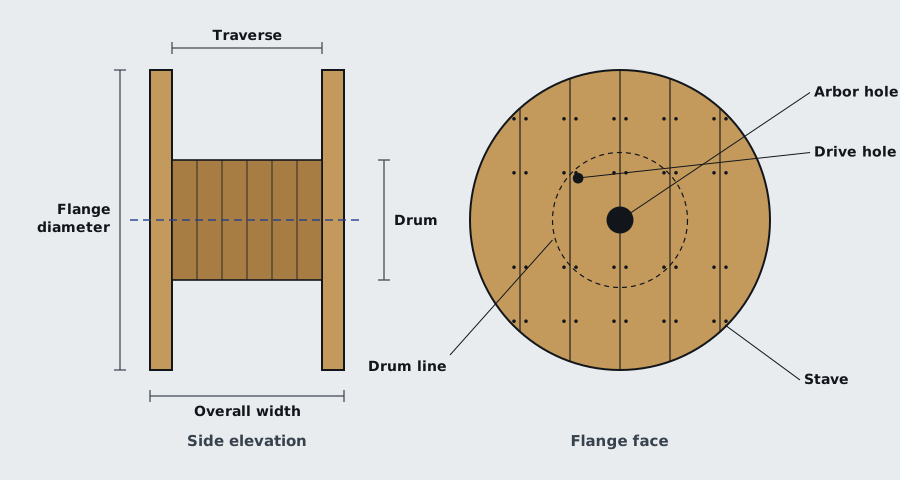
The four numbers
Flange. The diameter of the round end. Cable makers and the NEMA WC 26 standard size reels by it first, and so do we: 24, 30, 36, 42, 48, 60, 72, 84 and 96 inches cover nearly everything in a Southern California yard. A flange that has worn flat on one side from being rolled still counts at its full diameter.
Drum. The barrel the cable winds on. Its diameter is set by the cable: stiff, heavy cable needs a big drum so it does not bend too tightly. Okonite's reel table lists drums from about 10 inches on small reels to well over 40 on the largest. If you want to wind your own cable or hose onto a used reel, the drum must be at least as big as that product's minimum bending diameter.
Traverse. The inside width between the flanges. With the drum, it sets how much a reel holds. For a pickup it matters a little: a reel with a wide traverse takes more deck when it lies flat.
Overall width. Outside face to outside face, including bolts. Laid flat, this is how tall a reel stands, so it is the number that matters for a table: Okonite's 42 inch build is about 30 inches wide, which is dining-table height.
Some standard sizes
A sample of standard wooden reel builds from Okonite's published table, lightest build of each, in inches and pounds. Other makers' reels of the same name are close but not always identical.
| Name | Flange | Traverse | Drum | Overall width | Empty lb |
|---|---|---|---|---|---|
| 24 × 12 × 10 | 24 | 12 | 10 | 15 | 23 |
| 30 × 18 × 12 | 30 | 18 | 12 | 22 | 39 |
| 36 × 18 × 12 | 36 | 18 | 12 | 22.5 | 64 |
| 42 × 26 × 18 | 42 | 26 | 18 | 30 | 90 |
| 50 × 32 × 24 | 50 | 32 | 24 | 36.5 | 143 |
| 66 × 32 × 36 | 66 | 32 | 36 | 38.5 | 285 |
| 72 × 36 × 36 | 72 | 36 | 36 | 41.5 | 335 |
| 84 × 54 × 48 | 84 | 54 | 48 | 61.5 | 639 |
| 96 × 54 × 56 | 96 | 54 | 56 | 61.5 | 816 |
A 96 inch reel is four times the diameter of a 24 inch one and about four times as wide, but its empty weight is more than thirty times greater: 816 lb against 23. That is why big reels need machines to move them, and why they stand on edge on a truck: laid flat, a single 96 inch reel would cover almost the whole 102 inch width of a deck.
Reading a reel's name
Okonite's own example is a 96 × 48 × 56 reel: a 96 inch flange, a 48 inch inside traverse and a 56 inch drum. The overall width is not in the name; add both flange thicknesses to the traverse, plus any bolt heads. Reel numbers stencilled on a flange are a different thing: an owner's tracking number, not a size.
The arbor hole and drive hole
The arbor hole is the centre hole a reel stand's spindle goes through. Measure its diameter and look at its shape. A clean round hole means the reel can go on a stand again; a torn, oval or burned hole takes it out of service for cable and usually means recycling. The drive hole is the smaller hole beside it, where a pin turns the reel on a payoff stand. Both are part of how Service Wire, for instance, judges whether a returned reel is reusable.
What to send us
For a pickup: the flange size of each group and how many of each. If you like, add a photo of one flange with the tape across it. For a sale: the flange, the overall width, and a photo of the face and the arbor hole. That is all the measuring a request needs.
Tools
A 25 foot tape, a marker and a phone camera. For a big reel, a second person to hold the end of the tape across the flange. For a tall one, measure the flange on the ground where it touches, then double the distance from the ground to the arbor hole's centre as a check.
Words on this page
- Flange
- The round end of a reel; its diameter (24 to 96 inches and up) is how reels are sized, sorted and loaded.
- Drum
- The barrel between the flanges that the cable winds on; its diameter sets how much cable a reel holds.
- Traverse
- The inside width between the flanges; with the flange size it sets how much deck a reel takes up.
- Arbor hole
- The centre hole a reel stand's spindle goes through; a torn or oval arbor hole takes a reel out of service.
- Drive hole
- A smaller hole beside the arbor hole that a reel stand's drive pin turns the reel by.
Read next
Measuring questions
My flanges are different sizes. Which do I use?
The larger one. It is the one that touches the deck and decides how much room the reel takes.
Do I need to measure every reel?
No. Measure one from each obvious size group and count how many match it. Reels of one size from one job are usually identical.
Is a 40 inch reel a 36 or a 42?
Round up to 42 for planning. Rounding down is how trucks end up a few reels short of room.
Should I measure in metric?
Inches, please. North American reels are built and named in inches, and our planning figures are too. A tape with both scales is fine.
The flange edge is chewed. Where do I measure?
Across the most complete diameter you can find, through the arbor hole. A few missing inches of edge don't change the size group.
Why do two reels with the same flange weigh so differently?
Plank thickness, drum diameter and hardware. Okonite lists its 72 inch builds from 335 lb to 592 lb empty, all with the same flange.