
Reels by flange size and type
We collect wooden reels from 24-inch to 96-inch flanges: nailed or bolted, plank or plywood, one-way or returnable. The flange size decides how a reel loads and roughly what it weighs; the build decides where it goes afterwards. Steel and plastic reels belong to their owners, and we point you back to them.
By flange size
| Flange | Typical cable | Empties per 53 ft deck (est.) | Empty weight, lb | Request |
|---|---|---|---|---|
| 24 in | Control, data, small building wire | 416 | 23 to 24 | Request |
| 30 in | Building wire, control cable | 189 | 39 | Request |
| 36 in | Building wire and feeders | 102 | 64 to 77 | Request |
| 42 in | Feeders, heavier power cable | 60 | 90 to 100 | Request |
| 48 in | Power cable, duct, fibre | 26 to 30 | 106 to 177 | Request |
| 60 in | Utility and medium-voltage cable | 24 to 28 | 187 to 347 | Request |
| 72 in | Utility cable, duct | 20 to 24 | 204 to 592 | Request |
| 84 in | Heavy utility and industrial cable | 18 to 22 | 223 to 920 | Request |
| 96 in | The largest utility and transmission builds | 16 to 18 | 250 to 1,199 | Request |
By build
| Build | How to spot it | Where it usually goes | Request |
|---|---|---|---|
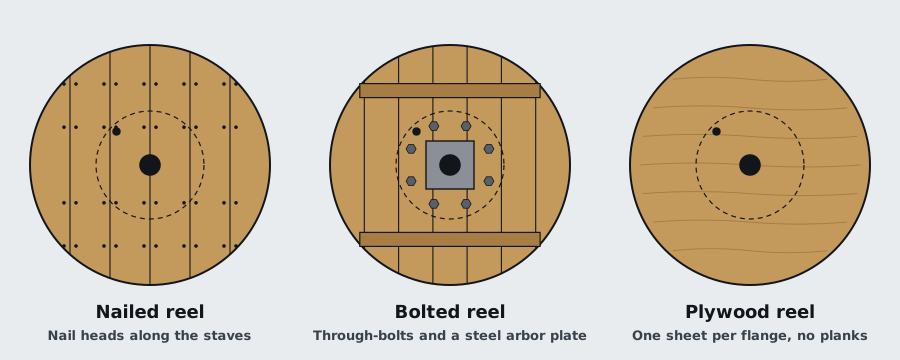
| Nailed | Nail or staple heads along the planks | Resale for light use, or wood recycling | Request |
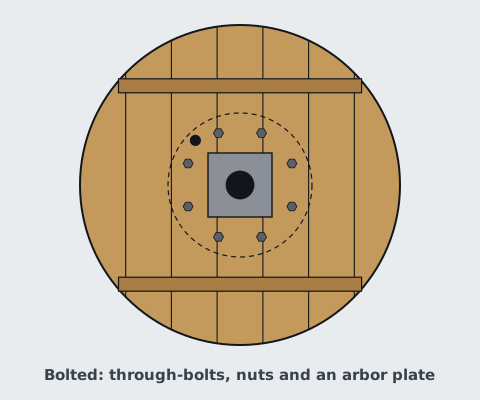
| Bolted | A ring of bolt heads around the drum, often a steel arbor plate | Back to its owner if stencilled, or resale for heavy use | Request |
| Plywood | Each flange cut from one sheet, no planks | Makers and light reuse, or recycling | Request |
| Returnable | An owner's name or number stencilled on the flange | Back to the owner first | Request |
| Steel or plastic | Metal or moulded flanges | Its owner, not our runs | Read |
Why sizes are standard
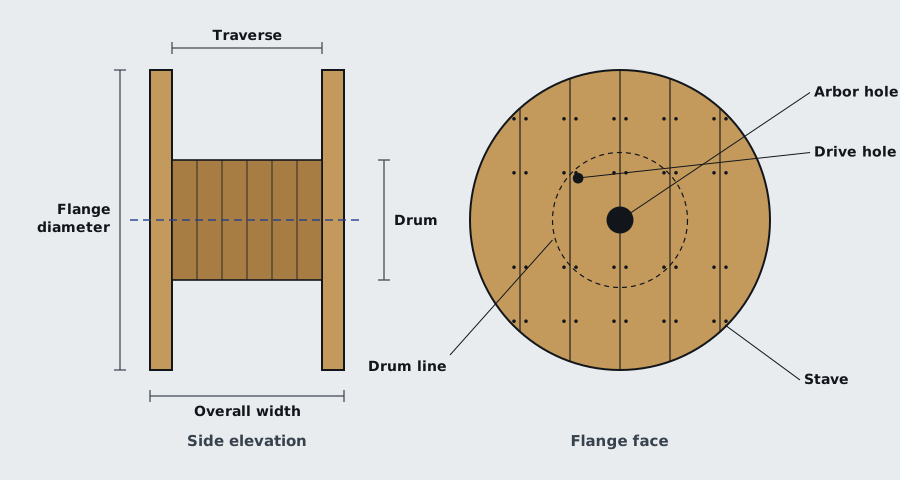
Wooden reels are standardised in NEMA WC 26, and cable makers name them in three numbers: the flange diameter, the inside traverse and the drum diameter. Okonite's reel table, for example, lists every size it ships with those three numbers plus the overall width and the empty weight. That standardisation is what lets us plan a truck from a phone message: "twenty 72s and a dozen 36s" means the same thing in Wilmington as it does in Victorville.
Reels are also used in huge numbers. Okonite alone bought more than 100,000 wooden reels in 2015 to ship its cable. Most of them end the job empty in somebody's yard, and that is where we come in.
Measuring the one you have
The flange is all we need for a pickup. Put a tape across the round end at its widest point and round to the nearest of our sizes. If you also want to sell a reel to a maker or a buyer, the traverse and drum help, because they decide how a reel works as a table or a stand. The measuring guide walks through all four numbers.
Sizes we also buy back for sale
Sound reels from our runs go out again to contractors, growers, makers and event planners. Tables are usually built from 24 to 36 inch reels; gardens and venues tend to use 48 inches and up. If you are on the buying side, start at buy wooden spools.
Words on this page
- Flange
- The round end of a reel; its diameter (24 to 96 inches and up) is how reels are sized, sorted and loaded.
- Drum
- The barrel between the flanges that the cable winds on; its diameter sets how much cable a reel holds.
- Traverse
- The inside width between the flanges; with the flange size it sets how much deck a reel takes up.
- Arbor hole
- The centre hole a reel stand's spindle goes through; a torn or oval arbor hole takes a reel out of service.
- Drive hole
- A smaller hole beside the arbor hole that a reel stand's drive pin turns the reel by.
- Stave
- One of the boards fixed around the drum between the flanges; loose or missing staves weaken a reel.
- One-way reel
- A reel meant to be used once and disposed of; the bulk of what sits in contractor yards.
- Returnable reel
- A reel the maker or distributor wants back, sometimes with a deposit, usually stencilled with the owner's name.
Read next
Reel questions
Which reel sizes pile up most?
In electrical contractors' yards, 24 to 36 inch reels are the most numerous. Utility and undergrounding work leaves fewer reels, but at 60 to 96 inches each one takes far more deck.
Do you take reels bigger than 96 inches?
Ask. Okonite's table runs up to 108 inch flanges. Reels that size are rare in a contractor's yard and too tall to stand on a flatbed legally, so they need a step deck or to travel flat.
Do you take reels smaller than 24 inches?
Yes, alongside larger ones. A stack of small reels on its own is better given to a maker or a school workshop.